Guides & Tips
Custom Printed Blinds with Your Logo for a Professional Office
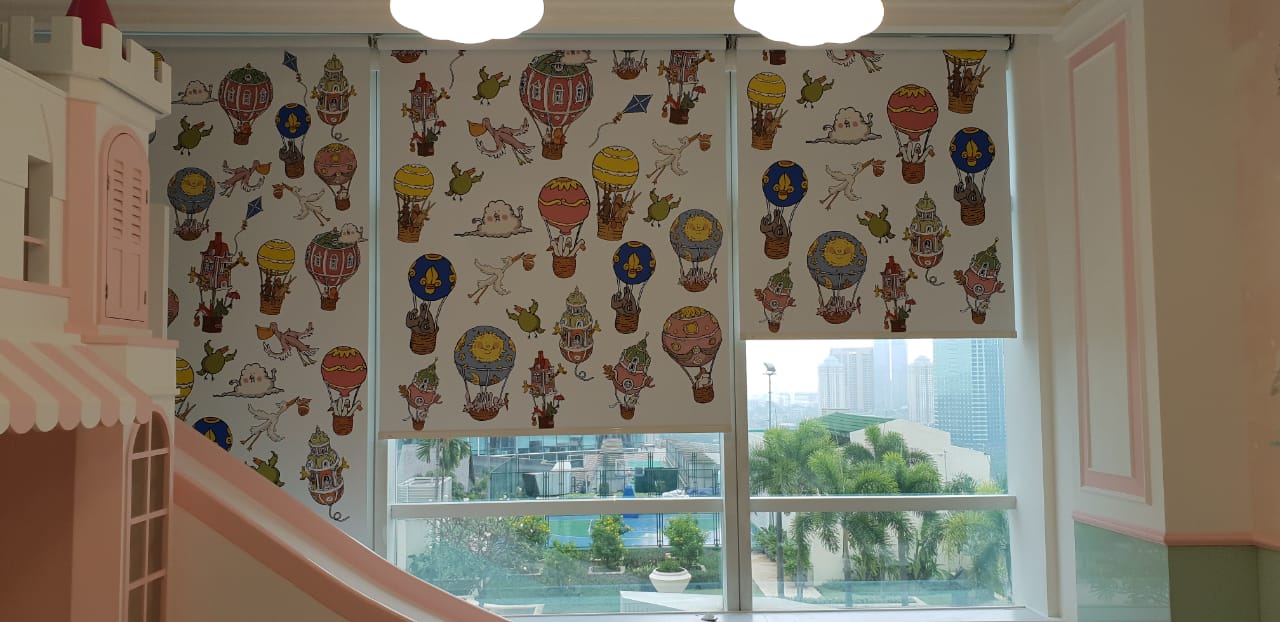
Most office branding dies fast: a sticker peels off within a year, a spandek banner sags, a glass film fades unevenly. Custom printed blinds with your logo behave differently. The mark is manufactured into the fabric, lasts as long as the blind itself, and turns windows you already own into a permanent branding surface. This guide covers why printed blinds work as an office branding medium, what can be printed, the exact production flow in our Jakarta workshop, and the design rules that keep the print sharp.
What if your logo hung on every window?
Send us the artwork file and we will return a printed colour sample on real fabric before you commit to the run.
Request a Print SampleTable of Contents
1. Why are printed blinds effective as office branding?
Because the logo does not sit on top of the blind – it is part of the blind. A sticker adds a layer that eventually bubbles, catches dust, and peels at the edges. A printed blind carries the mark inside the fabric surface, so there is nothing to peel, nothing to replace, and nothing to maintain beyond the regular dust routine.
Permanence is the first benefit. Office fit-outs run for years, and a branded window looks the same on month 36 as it did on day one. Integration is the second benefit: the logo follows the window plane instead of covering it, so the design language of the lobby, the meeting room, and the reception stays clean and intentional. Third, printed blinds remove the messy props entirely – no spandeks leaning against the wall, no temporary banners taped to glass, no stickers that cheapen an otherwise serious interior. For a professional office, that visual discipline is noticed by every client who walks through the door.
When you budget branding for a project, compare the cost of one printed blind run against repeated replacement of stickers, films, and banners. The blind is bought once and printed once, and it works every working day. For the full range of custom roller blinds from the MOWIN workshop, that is the promise: one accountable team from artwork to after-sales.
2. What can be printed on a roller blind?
Almost anything that stays sharp at a readable size. In practice, the most common printed elements in Jakarta office projects are:
- Logo – a single or repeated motif, typically across the reception window.
- Tagline or slogan – company name plus one line, printed horizontally.
- Corporate colours – block gradients or colour bands matched to the brand palette.
- Patterns – geometric or abstract repeats used across a full office floor.
- Photos and artwork – skyline views, product shots, and textures at reduced light transmission.
- Text for lobbies – reception names, floor directories, or welcome messages.
Because our roller fabric runs up to 2.8 m wide, a full-height lobby window can be printed as one continuous panel instead of stitched segments. You can also combine printing with function: one brand panel for the reception and screen, dimout, or blackout fabric everywhere else. Browse the options in our fabric and printed blind catalogue to build the mix for your floor.
3. What is the printed blind production flow?
The same disciplined flow as any made-to-measure blind, with one extra print stage in the middle:
- File review – our workshop checks resolution, format, and colour space before anything is produced.
- Colour sample – we print a small swatch on the real fabric so you approve the tone under office lighting.
- Print – the approved artwork is transferred onto roller fabric with UV-resistant printing.
- Assemble – the fabric is cut to exact size, hemmed, and mounted onto the roller and mechanism.
- Install – our own team installs on site and checks operation, alignment, and drop.
Two points make this flow safer than splitting work between a printing shop and a separate installer. First, everything sits under one accountable team from file review to the final on-site fix, so if a colour is off there is one call to make. Second, the print is done on real blind fabric, not generic banner media, so the material already matches the light-control grade the room needs.
For teams planning several buildings or dozens of units, wholesale pricing applies and the cost per printed panel drops. If you are still comparing options, our office roller blind buying tips and our guide to blinds coordinated with shop drawings cover the same questions in project settings.
4. What design rules give the best print result?
Five rules prevent the majority of bad prints we see:
- Work from vector files – logos and text in AI, PDF, EPS, or SVG scale without pixelation. Raster files are accepted when saved at high resolution.
- Keep 150 DPI minimum – at the full blind size, any lower resolution looks soft from two meters away.
- Avoid tiny details – fine lines under 1 mm, micro text, and dense gradients can blur after scaling onto fabric. Simplify decorative elements.
- Preview on the actual fabric – screen colours are brighter than textile colours. Approve a physical swatch before the full run starts.
- Use high-contrast colours – a white logo on dark corporate blue prints crisper than a light grey logo on white.
During the survey and coordination stage our team shares fabric swatches and colour guidance, so the artwork is built around the material rather than forced onto it. If the project is still on the drawing board, the same rules apply: keep the design system simple and the panels will look consistent from floor to floor.
5. How do you care for printed blinds and how long do they last?
Printed roller blinds are low-maintenance, and durability depends mostly on sun exposure. We use UV-resistant ink that resists fading, but Jakarta’s west-facing glass is aggressive. A printed blind at a window that receives direct afternoon sun will age faster than one in a shaded lobby, so during coordination we ask about exposure and recommend the right backing – screen, dimout, or blackout – and sometimes a lighter palette that reduces heat build-up.
The single best routine is light dusting with a soft brush or a vacuum attachment once a month. Do not machine wash or scrub the printed face. With basic care a printed blind keeps its colour and shape through years of daily operation, which is exactly what a branding investment should do. Compare screen, dimout, and blackout fabric behaviour if your window faces direct sun, and check more printed blind and project guides on our blog.